Wednesday, August 22, 2018

Eastern European Adventure, Day 3: Brzeg, Poland

Another full day at the plant, followed by dinner at the same place. In the mid-afternoon, we were informed that there was a small canteen restaurant in a building adjacent to the plant entrance where we could get lunch. We walked over there and had some cabbage soup and pierogis.


Yummy-looking, huh? Between work and dinner, I walked to the train station to purchase my ticket for Warsaw. There was an automated station with English instructions, which was pretty easy to navigate. Here's a map of Brzeg.


It's pronounced "Zheg," because the B is basically silent, and the R-Z combo adds up to a zh sound. 


This is Day 10. Here's the full list of posts from this trip:

Tuesday, August 21, 2018

Eastern European Adventure, Day 2: Brzeg, Poland


Worked at the plant all day, and eating lunch doesn’t appear to be a thing in Poland, so I was really hungry by dinnertime. Ate at the same restaurant again, this time a steak salad with some local beers.


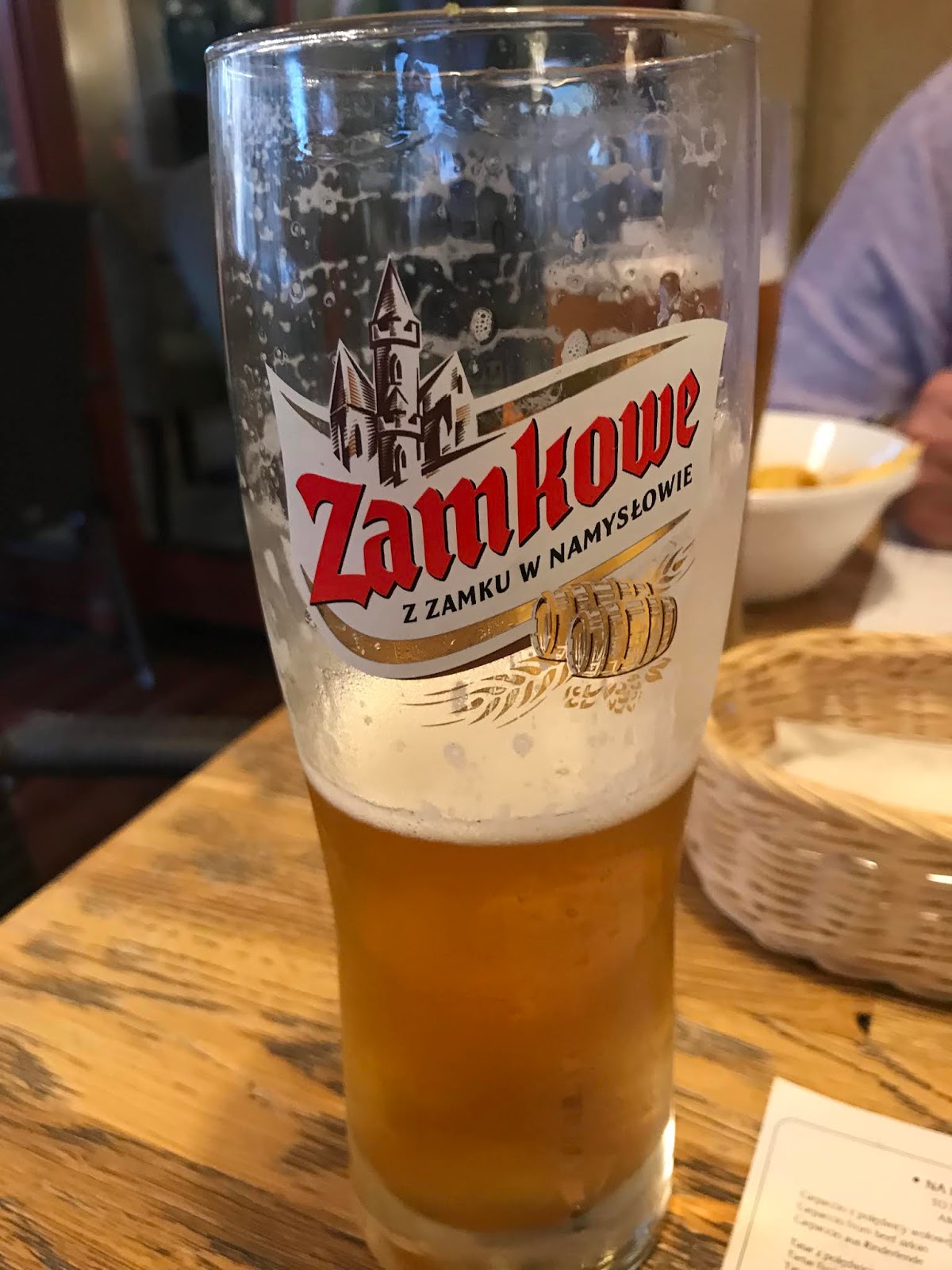
There was the option of either the local draft or a “bright” and “dark” Czech beer option. The local, Zamkowe, was a really nice lager from a town about 10 miles from Brzeg.

This is Day 2. Here's the full list of posts from this trip:

Monday, August 20, 2018

Eastern European Adventure, Day 1: MSP to Brzeg


Sunday, August 19
Flew out from MSP at 3 p.m. to Amsterdam, then to Warsaw.

Monday, August 20
Got to hang out in the KLM lounge in Amsterdam, which was better than not doing that. Napped a little on the flight to Warsaw, and then met up with guy from Crown Europe and he drove us to Brzeg. It was interstate for the first ¾ of the miles, but then the last hour and a half was on little country roads through small villages. The interstate had tall barriers alongside it in pretty much all the towns, which made it hard to see much of anything.


Once we got off the interstate, it was easier to get an idea of the area. The part of Poland between Warsaw and Brzeg is extremely flat, and mostly small farm fields. The rapeseed and wheat had already been harvested, and there were several fields of soybeans and corn, as well. I was totally beat by the time we got to our hotel, which was 7 p.m. or so. We had a couple of beers in the hotel bar and then walked around the town a little bit so that I could buy a toothbrush and kill some time before the rest of our work group arrived.


We had dinner at the Arte Hotel CafĂ© across the highway from our hotel. Brzeg is a town of about 30,000, and it’s quite nice. Pope John Paul II was from this part of Poland, and Frederick Chopin was from Poland as well, and their names are everywhere on streets and buildings.


This is Day 1. Here's the full list of posts from this trip:

Sunday, August 19, 2018

Book Report: Sharp Objects by Gillian Flynn


Sharp Objects is a very tense, uncomfortable book. I felt like I read most of it by looking between my fingers. That's not at all to say that it's a bad book, just that it is unrelenting in its yuckiness.

I'd heard of Gone Girl but never watched or read it, and I hadn't heard of Sharp Objects before the show came out on HBO. I don't read many "thrillers," so I don't have much in the genre to compare this to, but I thought that Flynn did an excellent job of keeping the plot moving. You may be able to guess who did it before the big reveal at the end, but I thought that there were enough possible suspects to make it interesting.

There are some ridiculous aspects, but it's not a bad book. It creeped me out enough that I'll probably avoid the show for a while, though.

Sunday, August 12, 2018

Book Report: Molly's Game by Molly Bloom


I watched Molly's Game, the major motion picture starring Jessica Chastain and Idris Elba, on a flight a few months ago, and I liked it so much that I requested the book that it's based on from the library. After reading some heavy science-based and more academic books recently, it was kind of nice to enjoy a breezy, somewhat vapid book for a change of pace. The pages flew by, man.

Molly Bloom (the sister of Jeremy Bloom, who was a world-class skier and also a wide receiver for the University of Colorado football team) moves to Los Angeles after her skiing career came to an end with no particular plan. As part of her job working for perhaps the worst person in the world, she ends up organizing high-stakes poker games for the Hollywood elite. When her boss tries to fire her and cut her out from the lucrative poker-organizing action, she turns the tables (see what I did there?) on him and takes control of the game herself. She is extremely successful as a game-runner, but eventually it all comes crashing down.

There's a shit-ton of money flying around in this book, even more than I was aware of during the movie. Since directly taking a cut of the action on the table is illegal, Bloom makes money through tips from the game participants, with the implication that if you tip poorly you won't get invited back. It's apparently nothing for most of these people to lose hundreds of thousands of dollars in a night. I can see where it would be tough to lose perspective in a situation like that, and Bloom does.

An interesting side note in the book (that doesn't figure into the movie) is that Bloom dates a son of Frank and Jamie McCourt, who owned the Los Angeles Dodgers at the time. The McCourts were shown to be vindictive bastards with an outrageously opulent lifestyle, but they come off as some of the more grounded and decent people in the book, which tells you something about the rest of the company Bloom keeps. Another thing is that Michael Cera's character in the movie is clearly based on Tobey Maguire, who if he's actually anything like how he's portrayed in the book, is a tremendously manipulative, petty sonofabitch.

Reading the book revealed some huge liberties that Aaron Sorkin took with the story for his screenplay, and I'm sorry to say that a lot of the parts of the movie that I liked were movie magic and had no basis in the actual story. For instance: Idris Elba's enjoyable lawyer character doesn't exist at all, and the skiing accident that is pretty much the framing device of the entire plot, didn't happen in anything approaching the way it's shown in the movie. Sorry if I ruined it for you, but I'm just passing along the favor done by the book.

Sunday, August 5, 2018

Book Report: The Botany of Desire by Michael Pollan


The Botany of Desire is full of fun facts! Especially the apple part of the book. There are also potato, marijuana, and tulip parts, but I enjoyed the apple part the most. Did you know that growing apple trees from seed is a complete crapshoot, and you don't know what kind of apple you'll get because they don't grow "true" from seed? Did you know that there wasn't any honey in the U.S. before European settlers brought honeybees along with them? Did you know that before refrigeration was developed, there was no such thing as non-alcoholic cider? All cider was hard cider. These are fun facts!

Pollan's central premise is that plants trick or manipulate humans into propagating them by providing sweet (exemplified by the apple), nourishing (potato), intoxicating (weed), or beautiful (tulip) vegetation or fruits. I think I buy that, although the cases for each and my level of interest in each varied widely. It's a pretty good book overall, and I feel like I learned a lot.

This was the September selection for the Boneshaker Science Book Club, and we had a good discussion.

Friday, August 3, 2018

Book Report: Ada's Algorithm by James Essinger


One of the troubles with procrastinating on writing these reports until a month or more after I finished the book is that for the more forgettable books, I don't have very strong recollections. Ada's Algorithm is not especially memorable, and not for Essinger's lack of effort in trying to make Ada Lovelace a memorable figure.

Since Lovelace died at a fairly young age and didn't publish her own work (the primary source for Essinger's book is her letters and a commentary that she provided for Charles Babbage's essay for his difference engine), a lot of his work is speculative. Both speculating on her state of mind, as well as on the significance, more than a century later, of what Lovelace foresaw about the future of computing. Essinger sweats all over the page trying to make the case that Lovelace was the real brains of the operation and had more of a vision for what the difference engine - and, more importantly, its never-built successor, the analytical engine - could become.

However, in order to make this case, Essinger chooses to make some pretty disparaging statements about Babbage, who, you know, actually made the thing, and who was attempting, with little success, to advance his creation further. While Lovelace was a genius in her own right, that doesn't require the diminishment of Babbage, and it's important to note that any advances she made were purely on paper. I think that if the gender roles were reversed and Babbage were being denigrated for the benefit of Lovelace, then that would be pure male chauvinism. I don't think that pursuing the same strategy to raise Lovelace's stature does her or Babbage any good.

Also, it's annoying how much of the early part of the book is spent on Lord Byron, Ada's absentee father and a real piece of shit human. Ada Lovelace is cool and amazing and good, but any effort that  this book makes to further that case is not beneficial to her.

Monday, July 2, 2018

Book Report: Rednecks, Queers and Country Music by Nadine Hubbs


A book with a faux-letterpressed cover about not just country music, but marginalized folks within that genre? That's going to play pretty well in our household. However, don't judge a book by its cover (sorry), because Rednecks, Queers, & Country Music is not very good.

The first problem is there just isn't much recorded country music that has any kind of pro-queer content. Hubbs dances around that fact, repeating herself over and over, but when you're devoting more than 1/3 of your book to an underground David Allen Coe album which is mostly about how he enjoyed getting head from dudes while he was in prison, then you're trying to create something that isn't there.

And Hubbs spent a good portion of the rest of book on Gretchen Wilson's "Redneck Woman," which she espouses as a country women's empowerment anthem. I remembered hating the song when it came out because it seemed as pandering as any Hot New Country song, and after giving it a fresh listen now, I still think it's not great. Being "country" is great, but I can't say that Wilson's version is any more enticing to me than 's. 

Hubbs did have one insight which I feel like is worth relating: in the early 20th century, being queer was more acceptable as part of working-class life (and it didn't even make you gay as long as you were giving instead of receiving), and was looked down upon by the middle and upper classes. However, as homosexuality became more socially accepted in the '80s and beyond, a lot of the movement momentum got co-opted by the middle and upper classes, and homophobia was assigned to the working classes. The evidence she presented for this was a little scant, but it rang true for me.

Tuesday, June 26, 2018

Book Report: Good Company by Douglas A. Harper


Good Company is a book from what turned out to be the last days of the white migrant worker riding freight trains from job to job, season to season. Doug Harper is a Ph.D. student at Brandeis, and he hops freights with a bunch of traveling workers on the way to pick fruit in Washington state. It's a good book. It changed my perspective on freight-hopping, which I never realized was a way to actually get to a particular place, or unofficially sanctioned by companies that need to get low-wage workers to where they need work done. Lots of stories about how the cops look the other way when they're riding the trains into town during apple-picking season, but they look for any excuse to run them off when the work is done. Kind of like how meatpacking employers don't review identification paperwork too closely nowadays.

Harper is really self-conscious about being accepted by the rest of the tramps, but realizing that he's got class advantages that they don't have while also needing to hide the fact that he's there as a reporter/academic. He's also trying to take photos, and most of the other guys don't want their photo taken, so there are quite a few photos as part of the book, but they don't lend a whole lot of insight.

I got this book off the free shelf at the library, and I think it's the original printing from the '70s. It looks like there was an additional edition in 2006 or so with a different cover design. I read most of this book on the plane ride(s) back from Indonesia for a work trip. Let me know if you want to borrow it. There aren't too many books giving a first-hand account of this lifestyle, and it does so without romanticizing it too much.

Tuesday, June 19, 2018

Book Report: Merle Haggard: The Running Kind by David Cantwell


Wow, I'm really behind on these book reports. My idea with starting them was mainly to keep a record of what I'd been reading, and then maybe I'd be more likely to stick with it if I posted it "publicly" (as much as a blog with a couple of family members as readers can be public). So, that was the thought, and I've been fairly disciplined about keeping track of what books I've read and uploading a photo of the cover into a draft blog post, but that's about as far as I've gone in the last three months. So, starting with this one, I'm working from a few-months-old recollection of the book, so bear with me.

David Cantwell does a very disciplined job with his topic as he chooses to address it in Merle Haggard: The Running Kind. He basically looks at the career of Merle Haggard by strictly sticking to his discography, drawing from the many biographies and autobiographies that have been published about the man, but not including any interviews of his own. This doesn't lead to any fresh new information being unearthed, but for the well-trod ground that is Haggard's life and career, it's not really necessary. I think that his distance from the subject allows for some unique insights.

For instance, that Hag has been straddling a very thin line over nearly all of his post-"Okie from Muskogee" career by pandering (and sometimes dog-whistling) to the racist redneck portion of his fanbase by producing some songs that equate whiteness and ruralness with hard work and upright living (and at best implicitly shitting on the urban and "other") while still trying to retain some ironic distance from outright racism and warmongering himself. And he's done this while being a felon (pardoned by Reagan when he was California governor, yay) who has struggled with financial issues, multiple marriages, infidelity, and drug and alcohol problems throughout his life. In the instance of a more enlightened song like "Irma Jackson" that never saw the light of day as single, Cantwell takes an appropriately skeptical stance on Haggard's claims that the record company shut him down.

Hag's had a helluva career, and "Mama Tried" and "Sing Me Back Home" are fucking bangers and among my favorite country songs. But from "Okie" to "Fightin' Side of Me" to "I Take a Lot of Pride In What I Am" to "Working Man Blues," there's just too much there that's ended up on the wrong side of history. He's been an asshole, and there's not enough in his discography to put him in the black.

Note: If you haven't already, listen to the Cocaine & Rhinestones episode about Merle and "Okie", which draws a lot from this book. 

Thursday, June 14, 2018

Surabaya, Indonesia: Day 6

Go back to Day 5
Go back to Day 4
Go back to Day 3
Go back to Day 2
Go back to Day 1

Food

I haven’t been very good about photographing my meals thus far this trip, so this post won’t be very visual to start with, but I’ll try to add to that as I take some more photos.

Since this is a work trip, my dining options are a little bit circumscribed by my circumstances. I need to catch the bus to the factory from the hotel lobby each morning at 7:30 a.m. Breakfast is a really nice, wide-ranging buffet served in the hotel, with everything from donuts to omelettes to stir fries. I’ve settled into a pattern where I’ll have one plate of salad and some beans and stir fry veggies, and then another plate of samples of each of the four rotating dishes from the “traditional corner” of Indonesian food, as well as some fresh melon. Then if I’m still hungry, I’ll have some muesli.


Lunch is a more basic, but still very nice buffet served in the canteen in the factory (Indonesian for “canteen” = kantin, pronounced the same – see, languages are easy ;-) ).


 That’s a big crock pot-o’-white-rice to start, with usually some broiled chicken leg-thigh combos, maybe a soup, some fried fish, a pot of green beans or boiled greens, and a big ol’ plate of watermelon for dessert.

Today was the last day before the Eid al-Fitr holiday, though, and the kitchen staff must have all bailed, because there was KFC-looking fried chicken and some McDonald's cheeseburgers.

Dinner in one of the hotel restaurants is included in the room rate, and that’s a really nice option to have, but I’ve been trying to get out and explore in the evenings when I have the time and energy.

Food in Surabaya is good. It tastes good. I wouldn’t say that local food in East Java is anything totally different from food in other southeast Asian countries (if you’re familiar with Thai or Malaysian food, you won’t be disoriented), but there are some distinctions to be made, for sure.
For protein, it’s mostly chicken-, fish-, prawn- and soy-based. The chickens are longer-legged and leaner than what we’re used to in the U.S., which is different but not better or worse. I haven’t seen a lot of breast served on its own, but it seems like the white meat is used more in stir-fries or other slow-cooked preparations. Satay, or chicken served on skewers, is a common thing. Fried chicken skin is also offered on a lot of menus: I had it as part of a dish last night and it was served cold, which wasn’t the best thing I’ve eaten here. I saw some chicken feet available from some street vendors, but not so much in restaurants. Eggs are served in all forms, at all meals; a fried egg on top of fried rice seems to be a staple, and breaded, hard-boiled eggs in many different styles are a thing.

It’s unclear to me which fish are commonly eaten here. The translations on menus don’t differentiate one fish from another, so I’m not sure. Seems like they’re usually fried, often served whole head-on or in chunks, and often with plenty of bones. Prawns are also served fried for the most part, and also commonly on skewers. Seems like a Applebee’s-style coconut shrimp (you know what I mean) has been the usual, and it’s delicious.


Surabaya is just a few hours away from the town of Tempeh, so it’s not surprise that there are plenty of tofu, tempeh, and mock-duck-style veggie proteins available. They’re often prepared in a spicy stir-fry sauce, and are uniformly tasty.

Beef is around, certainly much more than pork, but not nearly as common as chicken or seafood. Seems like the most common red meat is oxtail, which I’ve only had in soup so far.
As far as fruits go, I’m assuming that this is more of a seasonal thing, but it seems like the variety available here is less than what I saw in Malaysia when I was there a couple of years ago. I’ve mostly seen melons (cantaloupe, honeydew, and watermelon primarily), and pears and apples. I guess that the durian and mango season has already ended for the year, which is kind of a bummer. I haven’t seen any kiwi or star fruit or anything somewhat weird like that, and citrus appears to be served much more commonly in juices than as whole fruits.

The vegetables available and grown here that I’ve seen so far are not too far outside of what’s available in the U.S.: green beans, cabbage, sweet potatoes, white potatoes, etc. Oh, and peppers, lots of peppers. I’m not a connoisseur, so I can’t tell you what kind of peppers are used specifically, but shit can get spicy in a big hurry.

Rice is the carbohydrate staple, served in steamed or fried form with pretty much every meal. Potatoes and vermicelli noodles aren’t uncommon, but rice is king, and even on the way to the factory we drive by a couple of miles of paddies right on the outskirts of the city. I haven’t seen any chopsticks around; as far as I can tell, locals eat with a fork and spoon.

U.S. chain restaurants that I’ve seen so far in Surabaya:
KFC (lots of locations)
Starbucks
McDonald’s
Carl’s Jr
Pizza Hut
Burger King
Wing Stop

A&W

Another (I’m assuming) foreign chain that exists is Pizza en Bier, which has the “Bier” portion of its signage blacked out. I’m assuming that you can get beer in their non-Indonesian locations, and I’m curious how they’re getting by here.


I’ve poked around a few grocery stores, and the most unusual thing that jumped out at me is that they purchase their cooking oil or shortening in plastic bags in the shape of a large Capri Sun. I’m going to bring back some bags of broad beans and prawn crackers, both of which are pretty decent.


Surabaya, Indonesia: Day 7

Go back to Day 6
Go back to Day 5
Go back to Day 4
Go back to Day 3
Go back to Day 2
Go back to Day 1

Pedestrian and Bike Infrastructure


This post could be quite short: there is none.

However, while broadly accurate, it’s not quite fair, so I’ll try to be a little more descriptive than that. I’ve been picking my destinations for evening walks based on whether there is a decent way to walk there. I’ve gotten very spoiled in Minneapolis, and I expect to be able to walk somewhere without constantly needing to wander into traffic or run the possibility of falling into an open sewer. 

Basically, I’ve lost my sense of adventure as a pedestrian, and Surabaya has helped me rediscover it.
I have no idea how someone with even mild physical handicaps would navigate this city. There are few crosswalks, no walk/don’t walk signs, every curb is at least a foot tall with no cut-outs, and with the exception of a few broad boulevards with decent sidewalks, most sidewalks stop and start without warning and/or are intermittent and half-rotted unstable pieces of concrete laid over sewers running a couple of feet below the side of the roadway. Heaven help you if you are walking down one side of the street and see something you’d like to check out on the other side. You basically have wait for the torrent of cars and scooters to ebb slightly so you can wade through, trusting that they’ll slow down enough to let you by.

There just really aren’t any significant number of people who try to get around without a car or scooter, which on one hand I can totally see why, but on the other that creates a chicken-or-egg scenario where the infrastructure is terrible, so no one walks or bikes, or are cause and effect reversed? Do scooters and cars not respect the presence of pedestrians because all drivers are assholes, or does everyone seem like an asshole because there’s really never been a point of looking out to avoid pedestrians because they’re so rare?

Another side effect is that there’s no real way to be an effective bike commuter, so all bike shops and visible aspects of bike culture are centered around racing and triathlon. Which is a bummer, because in a city this size, there should be plenty of people to support a bike scene that doesn’t fetishize carbon components and lycra clothing, but that’s pretty much all there is. I did see this beautiful LeMond bike at a coffee shop called Wdnsdy, though:


Scooter culture seems to be much more diverse, by comparison, and seems to claim some of the territory that would be occupied by cyclists in a community with more viable transportation options. Scooters are used by everyone from the young, loud-pipes-save-lives show-offs to families of four carting around groceries to workers/vendors who need to haul huge amounts of stuff with them. That’s probably worth its own post, so I won’t go into more detail on that at this time.

Monday, June 11, 2018

Surabaya, Indonesia: Day 4

Go back to Day 3
Go back to Day 2
Go back to Day 1

Some Conversations on Politics and Government


Indonesian President Joko Widodo, known as Jokowi

H-, the project manager at W-, is from Davao City, Philippines, and also lived and worked in Manila before relocating to Surabaya about five years ago. He is married with three children, but his family remained in Manila when he relocated for work, and he sees them about every three months or so. I’m not sure the reason that his family didn’t move with him to Indonesia, and I will let him bring that up if he chooses, but I don’t feel right asking about it. If I had to guess, I would assume that it’s either that his family is culturally Christian and didn’t want to move to a Muslim country, or else that Manila (not having been there myself) is a much more cosmopolitan city than Surabaya, and it would be a step down quality of life-wise.

H- is an excellent project manager, extremely detail-oriented, organized, intelligent, and proactive. He is wonderful for me to work with in this situation, where I’m arriving not knowing anything about the work culture, and also lacking confidence in this particular process equipment. However, hyper-competent project management on a site level requires a bit of an autocratic streak, which H- also possesses. Please keep that in mind regarding his political opinions.

At lunch on Saturday, H- mentioned that Indonesia should be a very wealthy country, with all of their riches in oil, natural gas, and other natural resources, but that their government is corrupt. He didn’t go into specifics on this opinion, but that provided him a segue into his praise for Rodrigo Duterte, president of the Philippines and former mayor of Davao City. At least in the U.S. lefty media that I favor, Duterte is quite unpopular, regarded as something of a murderous despot because of the extrajudicial killings of drug addicts that he has directed and/or championed. I’ve often been curious about why Duterte’s approval ratings in his country are so high (consistently more than 70%, I’ve read) if he’s so awful.

Well, H- was very clear about his reasons for his strong support of Duterte:
  •         He’s provided much-increased financial assistance to the public and military hospitals in Manila, where care is now free of charge
  •         He’s streamlined the permitting process for businesses and reduced corruption by promising a decision on permits in something like 10 days
  •         He’s reduced corruption drastically in government and police; supposedly you can’t bribe Manila police anymore to get out of tickets
  •         He personally (and brutally) responds to business owner’s complaints; H- told a (possibly apocryphal – hey, this is all possibly apocryphal) story about a restauranteur in Manila who had an Australian patron who was smoking and wouldn’t put out his cigarette, even though public smoking in Manila is outlawed. The restauranteur called the government, and Duterte personally drove over to the restaurant and put a gun to the Australian’s head, and said he would either eat the cigarette or get his brains blown out. So, the story goes, the man ate the cigarette.
  •         And finally, he’s made Manila and other cities safe by either forcing drug addicts to surrender to be placed in rehab, or else they are killed. H- said that drug users get three warnings to surrender before they are killed.
  •         Generally, H- described Duterte as a man of impeccable integrity, doing what needed to be done to clean up corrupted institutions and reduce crime.

There’s definitely some stuff to like there, even if I disagree with some of the methods. I’m a softie, but maybe just arrest the addicts on the fourth try and send them to rehab forcibly rather than having them killed. Duterte has advertised himself as a man who Gets Things Done and Doesn’t Truck With Any Bullshit, and he delivers on those promises. I can see where that would be very appealing to a significant portion of the electorate.

After Trump was elected, I was hoping that maybe the silver lining would be that he could actually deliver on some useful things (less fucking around with overseas military interventions, for instance, or not kowtowing to the Israeli lobby) because of his lack of interest in decorum, but he has shown himself to be a dismal doer of things as well as an abominable person. He’s just a worthless shithead blowhard who wants to be praised for accomplishing things without actually doing them. At least Duterte is an effective doer of things, and I can see where a fellow doer of things like H- would see a kindred spirit.

My driver for part of the journey to Bromo, Leonard, is a Christian who grew up east of Bromo and has lived in Surabaya for the last twenty-plus years. He had very positive things to say about Joko Widodo (known as Jokowi), who is the current president of Indonesia. Jokowi was mayor of the city of Surakarta and governor of the state of Jakarta before being elected president in 2014. Leonard praised Jokowi’s ability to get things done, as well, citing a new highway running the length of Java that was nearly complete as evidence. Also, he pointed out that Jokowi had lowered the barriers for immigrants to enter Indonesia, which Leonard considers to be positive. Leonard expected Jokowi to be re-elected easily in 2019.

I asked whether Leonard’s church was near those that were bombed last month in Surabaya, and he said yes, that he was close enough that he heard the explosions when they happened. He was clearly saddened by the bombings, but he pointed out that Surabaya is a misguided place for ISIS to try to sow discord (the bombings were carried out by five members of a single family from Syria, is how it was explained to me). Surabaya as he described it, is a place where different religions respect each other and generally get along well. He said that it’s a place where anyone, even children, can walk the streets safely, and said that Jakarta was not like that. I can testify to the fact that I’ve felt very safe walking in Surabaya.

Leonard said that Surabaya mourned for two days after the bombings, and that the police presence has been more noticeable since then, but that after those two days everything got back to normal and people still treat each other the same way that they did before. I was glad to hear that because almost 17 years after 9/11, the U.S. is nowhere near that point. So, it’s not like terrorism has to lead to permanent mistrust and suspicion among different ethnic and religious groups. It’s almost as if the U.S. is worse at this than other places.

Go To Day 5

Sunday, June 10, 2018

Surabaya, Indonesia: Day 5

Go back to Day 4
Go back to Day 3
Go back to Day 2
Go back to Day 1

Bromo


At the end of the day on Saturday, H- told me that I didn’t need to come back to work until Monday. Day off, woo-hoo! I wasn’t expecting one of those while I was here, so I was a bit unprepared. My first idea was that I would go see the local professional soccer team, Persebaya, play on Saturday night. However, they were playing an away game, although they will be at home on this coming Saturday night.

Plan B: see what tour options are available through the hotel concierge desk. As luck would have it, they offered a tour to Bromo Ijen (which I thought were the same thing, more on that in a bit), some volcanoes a few hours away. I requested a day tour, and was informed that the sunrise tour would leave at midnight that (Saturday) night and return around noon. If I would confirm that I was in, they would try to find an English-speaking driver. It was nearly 8 p.m. by this time, but hey, YOLO, let’s do this. The concierge (a really sweet young lady with braces on both her top and bottom teeth) called back to confirm shortly thereafter, and Leonard would meet me in the lobby at midnight. The trip didn’t include food or horse rental (?), but the front desk could put together a breakfast for me since my room rate includes food.

I went to bed at 8:30, not difficult for my still-jet-lagged ass, and set the alarm for 11:46. I groggily walked down to the lobby, and Leonard was there, and wondered where my jacket was. Hardy Minnesotan that I am, I couldn’t foresee an occasion where I’d need to wear a jacket anywhere in Indonesia. “I’ll be fine,” I said, thinking very self-sufficient thoughts, and grabbed my box lunch from the front desk. Leonard drove me south out of Surabaya for a couple of hours while I unsuccessfully tried to get a little more sleep. The roads got bumpier and curvier the further we drove, and Leonard stopped in a parking lot in a small village, which had many canvas sheets covered in Arabica coffee beans, which had been harvested nearby and were now drying. There was also a badass ‘70s-era Toyota Land Cruiser, like you see in an old safari movie or something.


Leonard handed me off to my guide, Julian, and his apparently mute driver, and we piled into the Land Cruiser and headed up out of the village and into the mountains beyond. I was doing the mental calculations for the hourly rate for three people and the fuel being expended to cart me out of the city and into the mountains, and I could understand why the tour cost was as steep as it was. It was already significantly cooler than in the city. Leonard insisted that I would need a jacket, and he generously pulled his from a backpack in the hatch of the minivan and handed it to me.

The Land Cruiser came from a land long ago and far away before the existence of seat belts, although there was a handy strap above the passenger-side window to hang onto. The jeep was a four-speed manual with little in the way of exhaust muffling. Did it stall frequently while trying to turn around on the narrow roads? Dear reader, I assure you that it did. Was it quite loud and was there a strong fuel odor inside the vehicle at all times, requiring us to keep the windows halfway down? You know this to be true. The path of our jeep coincided with that of many others merging from several other parking lots along the road as we wound up the mountain, and I realized that perhaps there would be many others who chose this very night to also ascend to this specific spot.

As we curved through many villages with many homestays, hotels, and restaurants serving the tourist clientele, I realized that I was seeing signs for Bromo, but nothing that mentioned Ijen. I guess I’d assumed that “bromo” or “ijen” meant volcano, and that the other word in the phrase was a descriptor. Google translate was no help on this matter, and I realized I was in error when consulting a map: Ijen was a different volcano more than a three-hour drive away, and that I was headed to Bromo, which is the Indonesian word for Brahmin, the Hindu god. This is why it’s important to plan your travels for more than 15 minutes before leaving, to avoid these sort of embarrassing misunderstandings.

It was nearly 3 a.m. as we parked the jeep along a narrow road alongside many other jeeps and scooters in the pitch black and Julian and I shuffled the last ¼ mile past vendors offering souvenirs (most of which were stocking caps and scarves – Leonard’s jacket would come in very handy), cup-o-noodles, and hot beverages. We reached the viewing area, which was an amphitheater-like space atop Mount Pajaksthan (sp?) with concrete stairs for seating, and already more than a hundred fellow-travelers had gathered.

Sunrise wasn’t until 5 a.m., and I was seriously concerned about being bored to death shivering in the dark while occasionally being blinded by the flashlights of vendors walking by hawking jackets and blankets – Julian is an exceptionally nice person, but his English was broken enough that it made conversation pretty labor-intensive – but fortunately the couple standing next to me at the railing were recently-graduated medical students from England (she German by Sri Lankan extraction) who were on a three-month jaunt through Southeast Asia and happy to expound on their travels. I believe their names were Gulya and Thomas, and they had been on a minibus that entire previous day from Djojakarta through Borobudur and on to Bromo. They were leaving soon after sunrise as part of a tour group that was headed to Ijen and on to Bali. They were super nice folks, and I realized that I like most tourists that I meet who are traveling to out-of-the-way places. They generally are happy to put some effort into making their own fun and are more concerned with the richness of their experiences than the fanciness of their accommodations. I hope that I come off the same way to others.


The time passed pleasantly enough and before we knew it, there was enough light available for even our phone cameras to take stunning photos of Bromo and the surrounding peaks.


I realized that I had a time-lapse feature on my camera that I’d never played with, and I started goofing around with that trying to incorporate the now-massive crowd into the photos of the mountains.


At a little before 6 a.m., Julian (above) led me back to the jeep and we wound our way back down from Pajaksthan to the “Sand Sea”, the tabletop-flat desert area that surrounds the base of Bromo.


Julian asked if I wanted to rent a horse to carry me part of the way up to the Bromo crater, and then I understood why it was pointed out that that wasn’t included in the tour price. We walked along through the sand and past many locals renting horses and selling trinkets (Bromo’s a Hindu holy site, and there were several people selling flowers which were to be thrown into the crater as offering). I bought a fabric muff to put over my face to block the dust and also to cast a cool bandido vibe.


There were some Hindu figures carved into the rock on the walk toward the crater.


We reached the stairway which led to the top of the crater, and climbed up.


It appeared that it would have been possible to walk around the entire perimeter of the crater, but there was a lot of loose dirt on the rock, and the handrails ended pretty close to the top of the steps, so I decided that I would risk offering myself to Brahmin on this day.


We retraced our steps back to the jeep and headed back to the rendezvous point with Leonard. Along the way, we saw many different crops being grown, including cabbages, corn, green beans, garlic, lettuce, tomatoes, cucumbers, onions, and several others that I didn’t recognize. They were being grown in some cases on incredibly steep slopes.


We met back up with Leonard and bid goodbye to Julian and his quiet colleague. Leonard and I had a good conversation on the way back, some of which I recounted in the Day 4 post. Leonard took me to a great t-shirt shop on the way back to the hotel, where I picked up some gifts to bring home. I got back to the hotel at a little after 11 a.m. It was a great trip, and if you’re ever in East Java, I encourage you to check out Bromo.

Onward to Day 6